
Virtue® Male Sling System
Because moderate matters.
Moderate stress incontinence deserves a precise solution
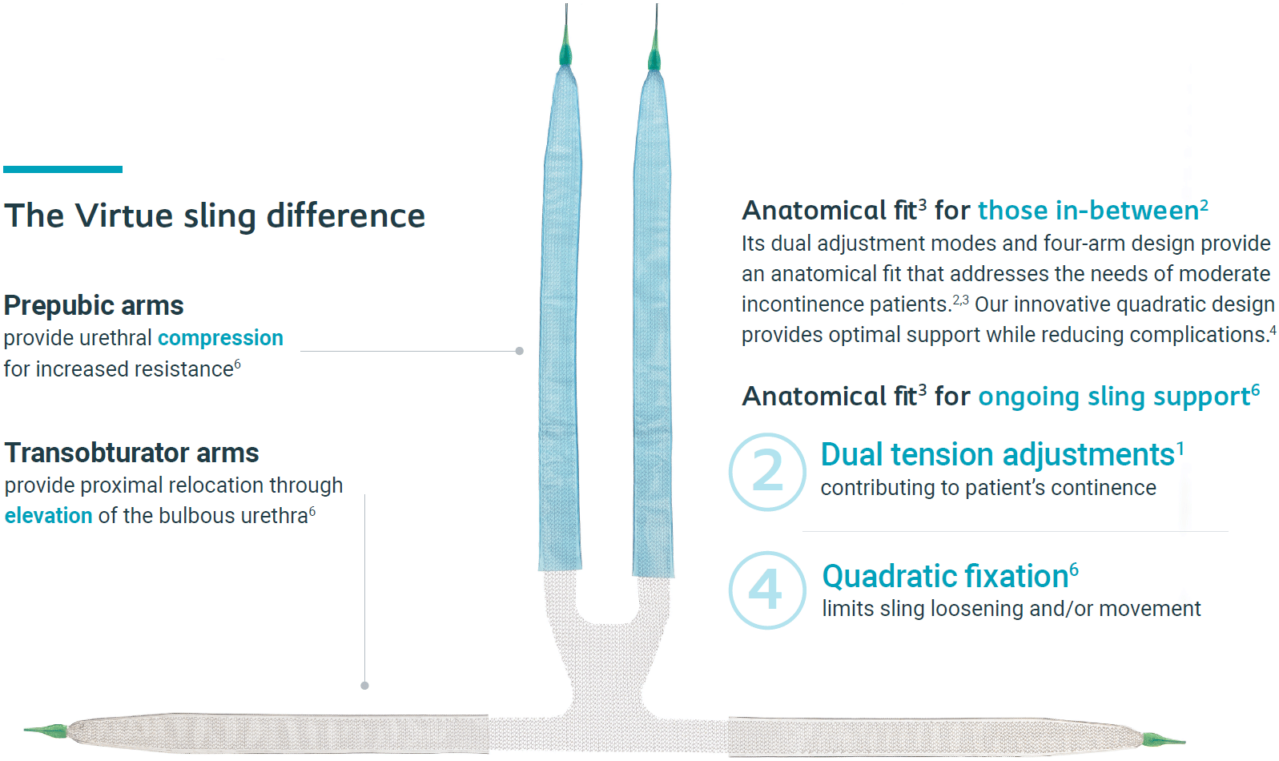
Virtue Male Sling’s dual mode of action fills the gap between standard slings and invasive treatments like the AUS. With its innovative four-arm design, the Virtue sling offers anatomical support to improve continence outcomes.


Minimally invasive for fast recovery
The Virtue sling allows your patients to return to their lifestyles fast*, with its minimally invasive approach. It’s a low complication procedure that gives you a strategic alternative to more invasive intervention like the AUS.
- Minimally invasive for fast recovery*
- Increased quality of life
- Safe and effective for all levels of incontinence

Why choose Virtue Male Sling?

Minimally invasive
For quick recovery*

Patient-centered design
Anatomical fit with ongoing sling support

Reliable performance
High success rate in 3-year clinical study
Virtue® Male Sling System Brief Statement
Indications
The Virtue Male Sling System is an implantable, suburethral support sling indicated for the treatment of male stress urinary incontinence (SUI).
Contraindications
The Virtue Male Sling is contraindicated in patients with one or more of the following conditions: Documented hypersensitivity or allergic reaction to polypropylene. Active infection, including untreated urinary tract and/or infection in the operative field. Patients with untreated or serious blood coagulation disorders. Patients with obstructive uropathy. Patients under the age of 18.
Warnings
It is the responsibility of the physician to advise prospective patients prior to surgery, of the warnings associated with the use of this product and the associated surgical risks. The Virtue Male Sling should only be implanted by physicians experienced in the surgical procedures and techniques involving placement of stress urinary incontinence slings.
A thorough assessment of each patient should be conducted, based on current medical practice guidelines, to determine the suitability of a sling procedure. Patients should be counseled that the Virtue Male Sling is permanent.
It is recommended that sling candidates are evaluated for overactive bladder syndrome and post-void residual. Residual sphincteric function should be considered prior to sling surgery.
It is recommended that sling candidates are evaluated for the presence of bladder neck contracture or urethral strictures prior to sling surgery.
The patient should be counseled to consider conservative incontinence treatments as well as other treatments.
Sling associated complications may result in one or more revision surgeries which may lead to partial or complete removal of the sling. Complete removal of the sling may not always be possible, and removal may not fully correct these complications. De novo complications may occur.
The additional risks versus benefits of Virtue Male Sling should be considered in patients with one or more of the following conditions:
auto-immune disease, coagulation disorder, connective tissue disease, debilitated or immunocompromised state, diabetes, pelvic radiation therapy, physical characteristics (e.g., body mass index), renal insufficiency, smoking related underlying conditions.
Potential Complications
Adverse events are known to occur with sling procedures and implants. Adverse events following sling implantation may be immediate or delayed, localized or systemic, de novo or worsening, acute or chronic, transient or permanent.
Adverse events may include but are not limited to: allergic reaction, hypersensitivity; autoinflammatory /autoimmunity syndrome; bladder storage symptoms (e.g., increased daytime frequency, urgency, nocturia, overactive bladder, urinary incontinence); bleeding/hemorrhage or hematoma, delayed/impaired/abnormal wound healing; exposure, extrusion or erosion of sling into other structures or organs; fistula formation; foreign body granuloma/scar tissue formation; genital paresthesia; infection; inflammation/irritation; male dyspareunia; necrosis; neuromuscular disorder; palpable mesh; pain; perforation or injury to adjacent muscles, nerves, vessels, structures, or organs (e.g., bone, bladder, urethra, ureters, bowel); seroma; sexual dysfunction; sling migration; urinary tract infection, urinary tract obstruction; voiding symptoms (e.g., dysuria, urinary retention, incomplete emptying, bladder outlet obstruction, straining, position-dependent voiding, slow stream).