

For men living with erectile dysfunction (ED), finding a dependable and straightforward treatment can be life-changing. Among the available options, the malleable penile prosthesis stands out for its simplicity, ease of use, and long-term reliability.
What Is a Malleable Penile Prosthesis?
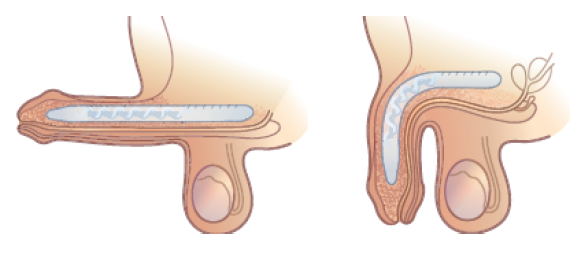
A malleable penile prosthesis is a non-inflatable device surgically implanted into the corpora cavernosa of the penis. It consists of bendable rods that can be manually positioned to simulate an erection. When not in use, the prosthesis is easily bent downward for discretion. This type of implant is ideal for patients seeking a simple and effective solution with minimal mechanical components.
Key Benefits for Patients
- Easy to Use: Patients can manually adjust the implant to an erect or flaccid position as needed.
- Reliable: With no springs, cables, or moving internal parts, this device offers dependable performance over time.
- Discreet: The prosthesis remains hidden under clothing and maintains a natural appearance
Why Consider a Malleable Implant?
For some patients, especially those with reduced dexterity or mobility challenges, a malleable option can offer greater
confidence and autonomy. It requires no manual inflation or mechanical manipulation, just a simple, intuitive motion
to achieve function.
Pre-Operative Preparation
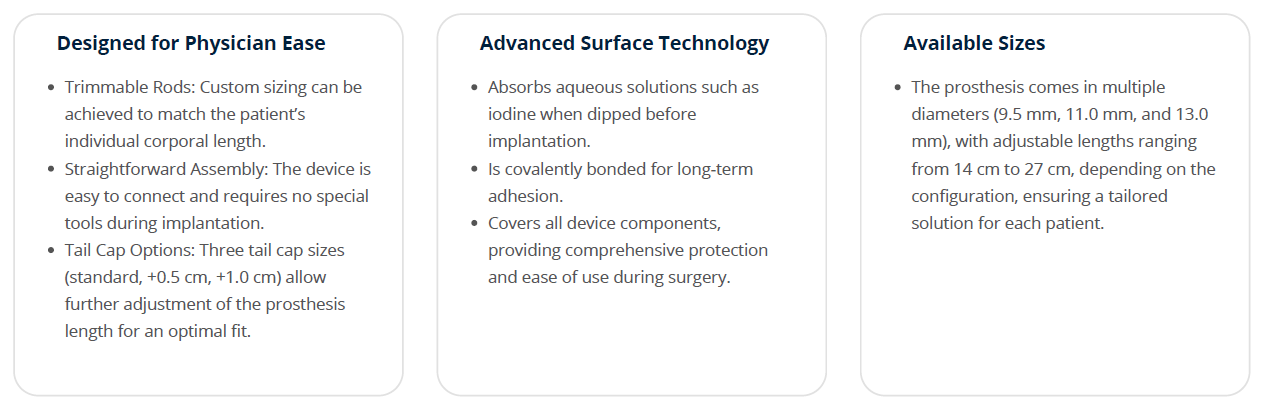
- Prosthesis diameters: 9.5 mm, 11.0 mm, 13.0 mm
- Malleable Sizer (or equivalent)
- Pelfrey or Furlow insertion tool
- Hegar or Brooks dilators (7 mm–14 mm)
- #10 or #15 blade for trimming
- Antibiotic solution (two basins: one for soaking, one for irrigation)
- Appropriate sutures and a sterile Mayo stand
Key Surgical Approaches
Penoscrotal
Perineal
Subcoronal
Dorsal
Infrapubic /
Suprapubic
Each approach allows the surgeon to access and prepare the corpora cavernosa appropriately, depending on the patient’s anatomy and surgical preference.
How a Malleable Penile Prosthesis is Implanted
Size Selection
- Dilate the corpora thoroughly, both distally and proximally.
- Measure using the Malleable Sizer from a consistent reference point.
- Combine both measurements to determine total implant length.
- Combine both measurements to determine total implant length.
Placement of the Prosthesis
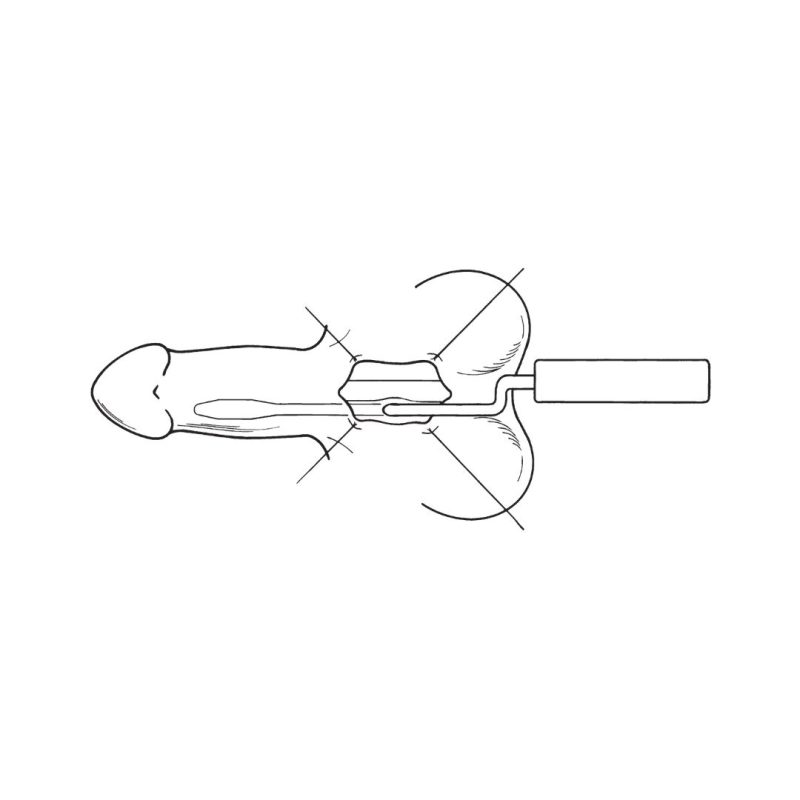
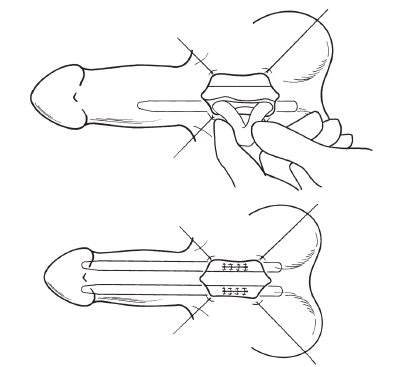
- Make a 1.5–2-inch incision in the midline raphe.
- Dissect tissue layers to expose the tunica albuginea.
- Place stay sutures and incise each corpus.
- Dilate fully, ensuring distal reach beneath the glans.
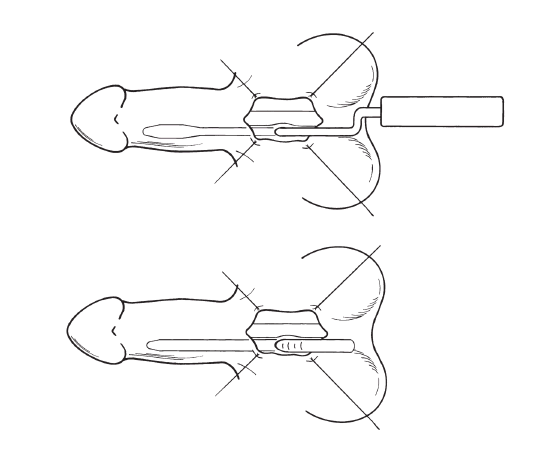
- Cut the device to size and attach the appropriate tail cap.
- Confirm proper placement: ends aligned and no bowing or buckling.
- Close layers securely, and follow the surgeon’s preferred dressing protocol.
Addressing Common AdjustmentsA
- Too long? Retrim and reattach the tail cap if not below the minimum.
- Too short? Replace the tail cap with a longer one (+0.5 cm or +1.0 cm).
- Inadequate bend? Consider prosthesis length, diameter, or anatomical restrictions.
Sterilisation Guide
- Use autoclave settings (gravity displacement or pre-vacuum at 132°C).
- Do not sterilise in the original packaging.
- Follow aseptic handling practices throughout.